








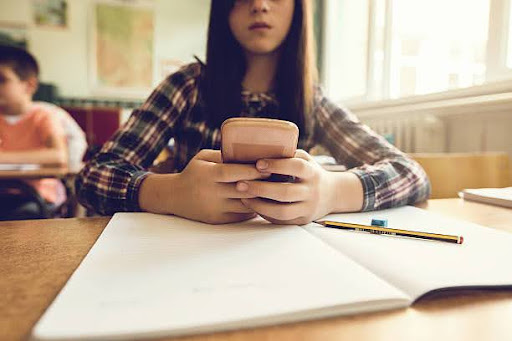




At the start of the 2025-2026 school year, a major change impacted classrooms across New York State: cell phone usage is now restricted throughout the school day. On May 9th, 2025, New York State Governor Kathy Hochul signed an amendment into law that prevents cell phone use during school hours. However, schools were given the flexibility to decide how to enforce it.
With constant access to a digital world at our fingertips suddenly being taken away, students need to adjust to this new school day without the comfort of their screens. For some, this new law may be seen as a frustrating limitation, while for others, this new law may be surprisingly refreshing. Instead of spending screen time scrolling, many students have been talking more with their classmates, revisiting old hobbies, or simply just taking a break from their screens. However, teachers and parents have mixed feelings. For parents, a big concern is now being able to communicate with their children during emergencies. With phone use off limits, students must now use the main office to call home, a process that can be inconvenient and slow in emergency situations.
To better understand how this law is playing out in classrooms, here are some student and teacher perspectives on the ban.
When asked if student engagement has improved in class following the ban, one teacher replied, “Students are a lot less distracted. They focus on the lesson, and they’re putting more time and effort into their in class assignments, in my opinion. They’re also talking to each other more which is nice.” According to this teacher, enforcing the rule hasn’t been too difficult either. “I usually just need to do one gentle reminder and they’ll put it away,” she explained. The teacher also shared a noticeable improvement in productivity. “Last year, more than half of my seniors scrolled through TikTok thinking of ideas for their college essays. This year, a majority of my students were done within four to five days. That was hugely impressive and awesome to see.” While she admits limited phone use could be useful, such as taking a photo for homework, she doesn’t find phones necessary for classrooms. Overall, she believes that the change is beneficial for school culture. “I think it’s going to be massively beneficial and hopefully we will only continue to actually talk to each other and actually interact outside of our screens,” she explained.
Not all students share the same enthusiasm. For many, the sudden shift away from phones has disrupted their daily routines and habits. “I would prefer to have my phone to reach out to my parents, but now I can’t,” said one student. “I can’t listen to music. I want to listen to music while I study in study hall,” said another. Others say the change hasn’t affected them as much. “I don’t think it affects me that much since I don’t really need my phone in class,” one student admitted. During lunch and free periods, students found other ways to pass time such as going to the library, studying, reading, or even listening to music on MP3 players. Opinions were however divided when asked if the ban helped students’ social lives. “I don’t really think it’s going to do anything,” one student said. “I’m not planning on bonding with people just because I don’t have anything better to do. I’ll literally just sit in a corner in silence.” Communication has become trickier as well, and most students said they’d like to loosen up the restrictions, or get rid of it entirely. Multiple students voiced that the ban isn’t as effective or easy as “phone jails” in the classroom. Another student added, “Honestly, it should be the teachers’ decision if they want the policy or not.”
As schools continue adjusting to the new law, it’s clear that both teachers and students will need to find comfort with this change. While some see it as beneficial, others view it as an unnecessary frustration. For now, one thing is certain: students may be, just maybe, be a little more connected in real life.